
To Psoas and beyond………..
Why Your Hip Flexors Are Running the Show Physically And Mentally — And What Madison Professionals Can Do About It
Sam Riddle Massage Therapy | Madison, Wisconsin
"Tight hip flexors causing low back pain, stress, or poor posture? Madison, WI massage therapist Sam Riddle targets the psoas and hip flexors for lasting relief. Book today."
You sit through back-to-back meetings. You power through a full day at a desk. You commute, you respond to emails, you keep moving — because in your world, slowing down is not an option. But there is something happening deep inside your body while you push through all of it, something quiet and cumulative, and eventually it makes itself impossible to ignore.
Your hip flexors are tightening. Every hour you spend seated, they shorten a little more. When you finally stand up, they pull your pelvis forward, throw your spine out of alignment, and force the rest of your postural muscles into overdrive just to keep you upright. For Madison-area professionals who depend on their bodies to perform — and who cannot afford to be sidelined by pain — understanding what is happening in this muscle group is one of the most important things you can do for your long-term health.
This is not just about tightness or soreness. The story of the hip flexors, and particularly the psoas, touches your posture, your breath, your low back pain, and even your ability to manage stress. Let's break it down — and talk about what targeted clinical massage therapy can do to reset the whole system.
Your Hip Flexors Are Asking for Help.
Madison-area professionals — don't wait until pain forces you to slow down. Sam Riddle Massage Therapy offers targeted clinical massage to release your hip flexors, calm your nervous system, and get you back to your best.
The Hip Flexors: What They Are and Why They Matter More Than You Think
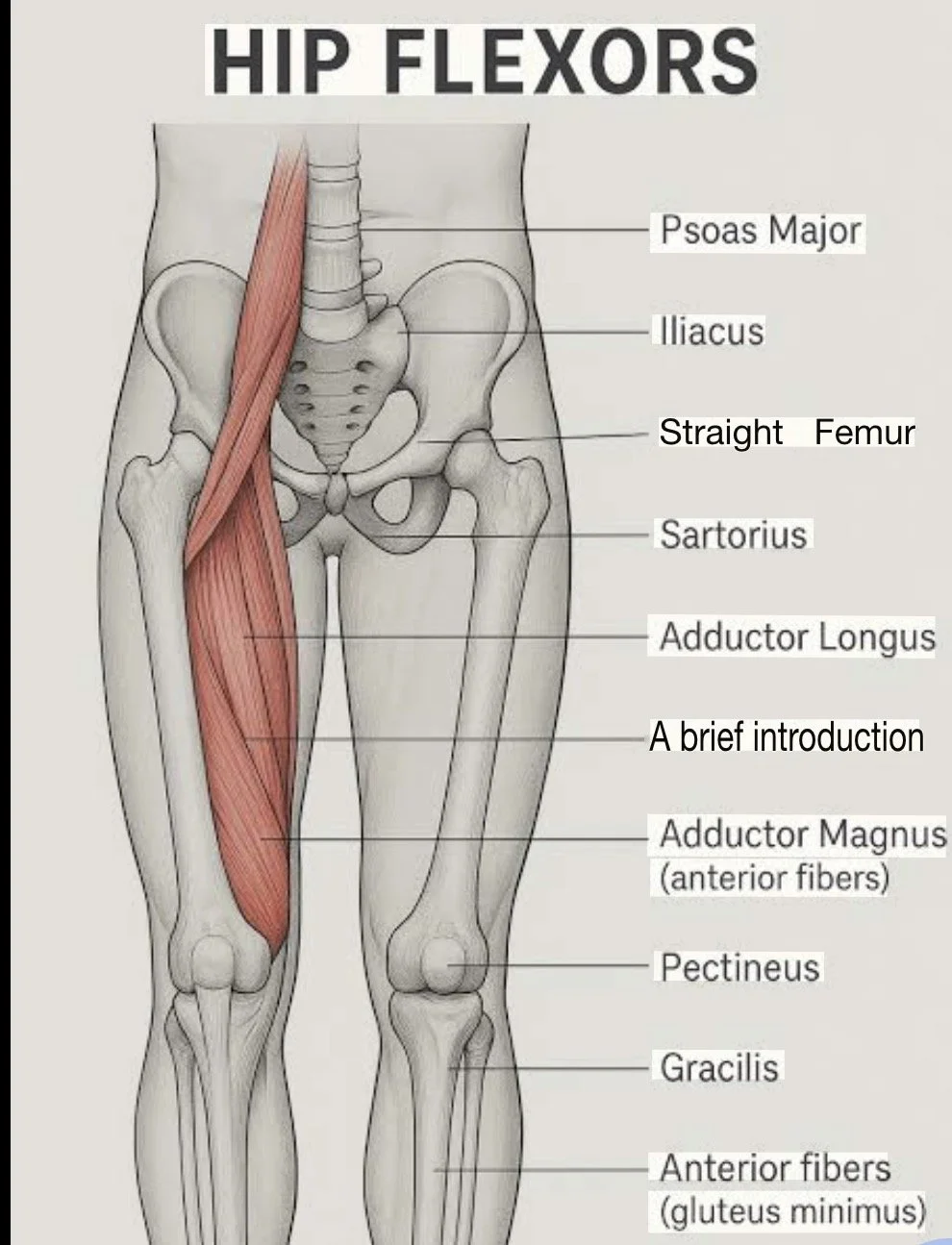
Most people think of hip flexors as a single muscle. In reality, they are a team — and each member plays a specific role in how you move, stand, and stabilize your entire lower body. When even one player on that team stops doing their job properly, everyone else compensates, and that compensation is where pain and dysfunction are born.
The Prime Movers: Psoas and Iliacus
The two most powerful hip flexors are the psoas major (and its smaller partner, psoas minor) and the iliacus. Together, they are often called the iliopsoas, and they are the deepest muscles in the body. The psoas attaches to every lumbar vertebra of your lower spine and runs all the way down to the top of your femur — making it the only muscle that directly connects your spine to your legs.
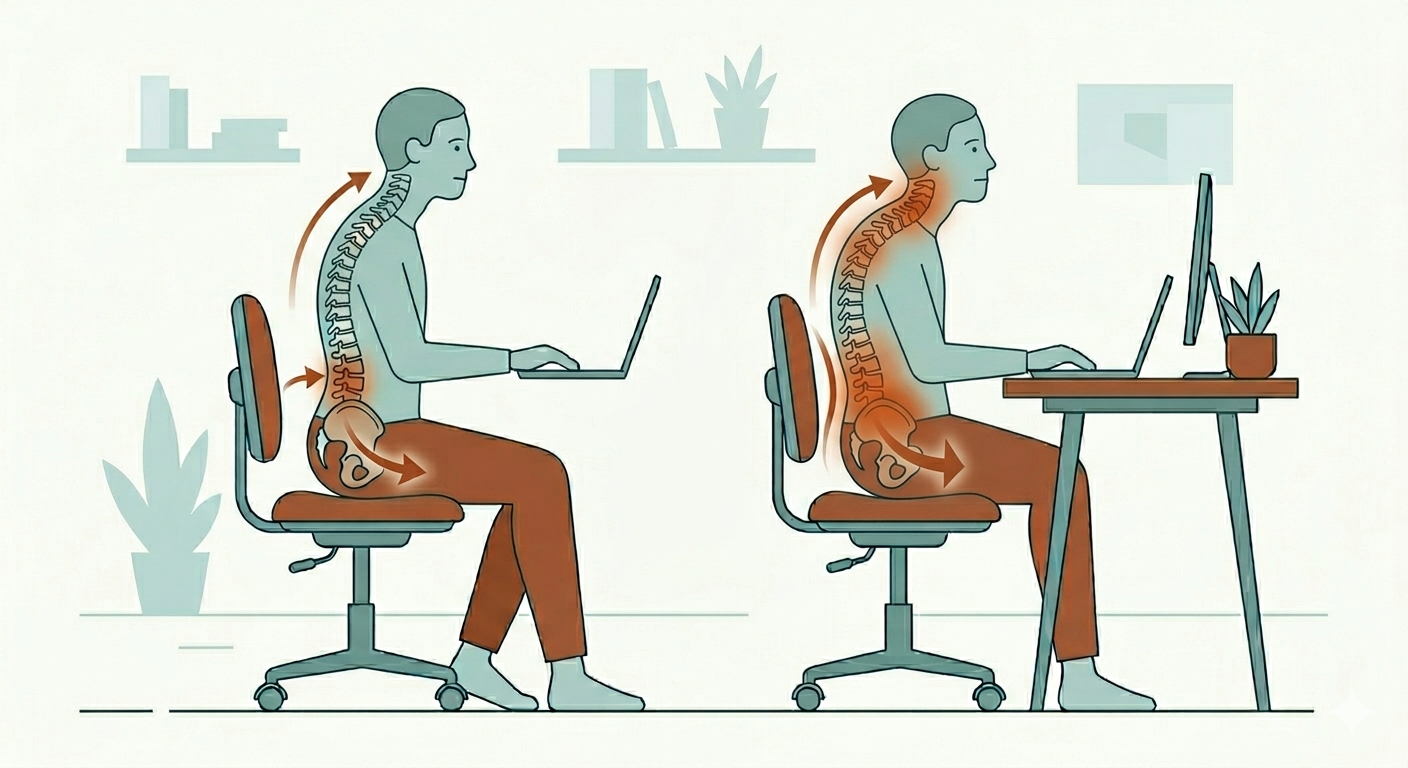
These two muscles do far more than just lift your knee. They are postural stabilizers, meaning they are always working in the background to keep you upright. When they shorten from prolonged sitting — a daily reality for most Madison office workers, attorneys, healthcare administrators, and remote professionals — they begin pulling the lumbar spine forward, flattening or exaggerating the natural curve and creating a breeding ground for low back pain.
The Supporting Cast: Secondary Hip Flexors
Beyond the iliopsoas, a whole group of muscles contributes to hip flexion as a secondary function. The rectus femoris (part of your quad), the sartorius, tensor fascia latae, pectineus, the adductor group (magnus, longus, and brevis), gracilis, and even the gluteus medius and minimus all have roles that cross the hip. Their primary jobs may be adduction, abduction, or rotation — but when they are called in to compensate for a dysfunctional psoas, they get overloaded and painful themselves.
Think of this as a workplace analogy: when the team leader is struggling, everyone else picks up extra work. Eventually the whole team burns out. Targeted massage therapy addresses not just the primary movers but the entire supporting cast, restoring balance so no single muscle has to carry more than its share.
The Domino Effect on Posture: From Pelvis to Neck
Here is something most people do not realize: tight hip flexors do not just cause problems at the hip. When the pelvis tilts forward from chronic psoas shortening, the lumbar spine arches, the mid-back rounds to compensate, and the head juts forward to keep the eyes level. That is a full-body postural chain reaction — and it originates in a muscle most people have never consciously thought about.
For Madison professionals dealing with neck tension, mid-back stiffness, or chronic headaches, the root cause may actually be sitting four feet below where the pain lives. Madison Masage therapy, Expert Guide to Desk Set Up & Pain Relief.
The Psoas–Stress Connection: Why Your Most Important Hip Flexor Is Also a Stress Organ
Of all the hip flexors, the psoas carries the most complex and far-reaching role in the body. Its influence goes well beyond movement and posture. To understand why high-performing, high-stress professionals in Madison are especially vulnerable to psoas dysfunction, you need to understand what this muscle does when life gets hard.
The Psoas and Your Breath: A Direct Anatomical Link
At its upper end, the psoas major does something remarkable: its fibers blend into the diaphragm, the primary muscle of breathing. This is not a metaphor or a holistic abstraction — it is anatomy. A chronically tight psoas physically restricts the full range of motion of the diaphragm, making it harder to take a deep, belly-filling breath. If you have ever noticed that you cannot seem to get a truly full breath when you are anxious or tense, your psoas may be a significant contributor. Leila Stewart speaks remarkably about this.
Shallow breathing does not just feel uncomfortable — it actively signals danger to the brain. The nervous system interprets short, rapid breaths as evidence of threat, keeping the fight-or-flight response running even when the actual stressor has passed. For Madison professionals navigating deadline pressure, leadership responsibility, or the relentless stimulation of a connected work life, this creates a feedback loop that is genuinely difficult to escape on willpower alone.
The Stress Loop: Psoas, Anxiety, and the Sympathetic Nervous System
The psoas is the first muscle to contract when you are startled, scared, or anxious. It is part of the ancient curl reflex — the same protective response that makes you flinch or crouch when something threatens you. In acute situations, this is adaptive. In the context of chronic stress, it becomes a problem. The psoas contracts, restricts the breath, the restricted breath signals the brain to stay alert, and the elevated alertness keeps the psoas contracted. Around and around it goes.
This is where the psoas earns its reputation as what Ayurvedic and traditional Chinese medicine practitioners have long called the seat of the solar plexus — the place in the body where we "digest" our emotions. Whether you frame it through an Eastern or Western lens, the physiological reality is the same: unresolved stress lives in this muscle, and a tight psoas is often the physical residue of a nervous system that has been in overdrive for too long. samriddlemassage.com
The Vagus Nerve, the Breath, and the Brake Pedal
There is a way out of the loop, and it runs through the vagus nerve — the primary channel of the parasympathetic nervous system, the system responsible for rest, recovery, and the feeling of being genuinely okay. Deep, slow, diaphragmatic breathing activates vagal tone and triggers the calming response. But if the psoas is tight and the diaphragm is restricted, accessing that kind of breath is physically impaired.
Professional massage therapy that specifically targets the psoas and surrounding hip flexor tissue can interrupt this cycle at its physical source. By releasing the mechanical tension in the muscle, we restore range of motion to the diaphragm, support deeper breathing, and create the physiological conditions in which the vagus nerve can finally do its job. For stressed professionals in Madison, this is not a luxury treatment — it is targeted clinical intervention with real, measurable impact on both pain and stress response.
Hip Flexors and Low Back Pain: The Mechanism Madison Professionals Need to Understand
Low back pain is one of the leading reasons people miss work in the United States, and the hip flexors are among the most common — and most overlooked — drivers of it. Understanding the mechanism does not just help you understand your pain; it helps you understand why treating the symptom alone never produces lasting relief.
How Short Hip Flexors Force the Multifidus to Never Rest
When you stand up after a long meeting or a morning at your desk, your shortened hip flexors pull the pelvis forward. Your body's immediate response is to activate the multifidus — a deep spinal stabilizer that runs the length of the lumbar spine — to prevent you from folding forward. In a healthy body, the multifidus contracts and relaxes as needed. When the hip flexors are chronically short, the multifidus never gets to turn off.
Here is why that matters: research has shown that after sustained contraction — like holding a bent-over position for 20 minutes of yard work — the multifidus can take seven hours or more to fully recover and relax. Imagine that muscle running near-constantly throughout a full work day. The result is the deep, nagging, won't-quite-go-away low back ache that so many Madison desk workers know intimately. Stretching and ibuprofen address the symptom. Releasing the hip flexors addresses the cause.
Pelvic Imbalance: When One Side Shortens More Than the Other
The psoas and iliacus are bilateral — you have one on each side. And in most people, especially those who cross their legs habitually, favor one hip when sitting, or carry bags on one shoulder, one side tightens more than the other. The result is a pelvic imbalance: one side of the pelvis sits higher or tilts more than the other. This asymmetry creates uneven loading on the lumbar discs, uneven tension in the hip joint, and a compensatory pattern that eventually works its way up the spine and down into the knees.
This is a significant reason why a runner's knee, a tight IT band, or a shoulder that never quite feels even can trace its roots to hip flexor imbalance. At Sam Riddle Massage Therapy, assessment of pelvic symmetry and hip flexor balance is a foundational part of the clinical approach — because lasting results require understanding what is actually driving the pattern. samriddlemassage.com
Why Professional Athletes and High Performers Prioritize Hip Flexor Work
Elite athletes have known for decades that hip flexor health is non-negotiable. Sprint speed, jumping power, rotational force in golf or tennis, and even cycling efficiency all depend on hip flexors that move through their full range without restriction. But this is equally true for Madison professionals whose "performance" happens in a boardroom, a courtroom, or a hospital.
When your body is compensating for tight hip flexors and chronic low back tension, a portion of your cognitive and physical energy is always allocated to managing that discomfort. Regular therapeutic work on the hip flexors and psoas is an investment in your capacity to show up fully — not just physically, but mentally. The professionals who come to see Sam Riddle are not waiting until they are injured to seek care. They are maintaining a body that supports the demands they place on it.
You Can't Afford to Ignore This
The hip flexors are not a niche concern for athletes or yoga practitioners. They are a foundational element of how every human body holds itself upright, manages stress, and moves through the world. For professionals in Madison, Wisconsin who are sitting for long hours, operating under sustained pressure, and expecting their bodies to keep pace with demanding lives, the hip flexors — and the psoas in particular — deserve serious attention.
Chronic low back pain, shallow breathing, difficulty calming down after a stressful day, postural fatigue that accumulates through the week — these are not just signs of aging or overwork. They are often signals that the hip flexor group, and the psoas at its center, needs therapeutic intervention. The good news is that targeted, skilled massage therapy can create meaningful, lasting change in this tissue — and in how you feel day to day.
Sam Riddle Massage Therapy works with Madison-area professionals at exactly this intersection of clinical precision and mind-body awareness. Whether you are dealing with a specific injury, managing chronic pain, or simply investing in the maintenance your body has earned, the work starts here. Do not wait until pain makes the decision for you.
Your Hip Flexors Are Asking for Help.
Madison-area desk workers — don't wait until pain forces you to slow down. Sam Riddle Massage Therapy offers targeted clinical massage to release your hip flexors, calm your nervous system, and get you back to your best.