
WHERE IS THAT HEADACHE COMING FROM?
Why Your Headache Might Actually Be Starting in Your Neck and Shoulders
By Sam Riddle · Sam Riddle Massage Therapy · Greater Madison, WI
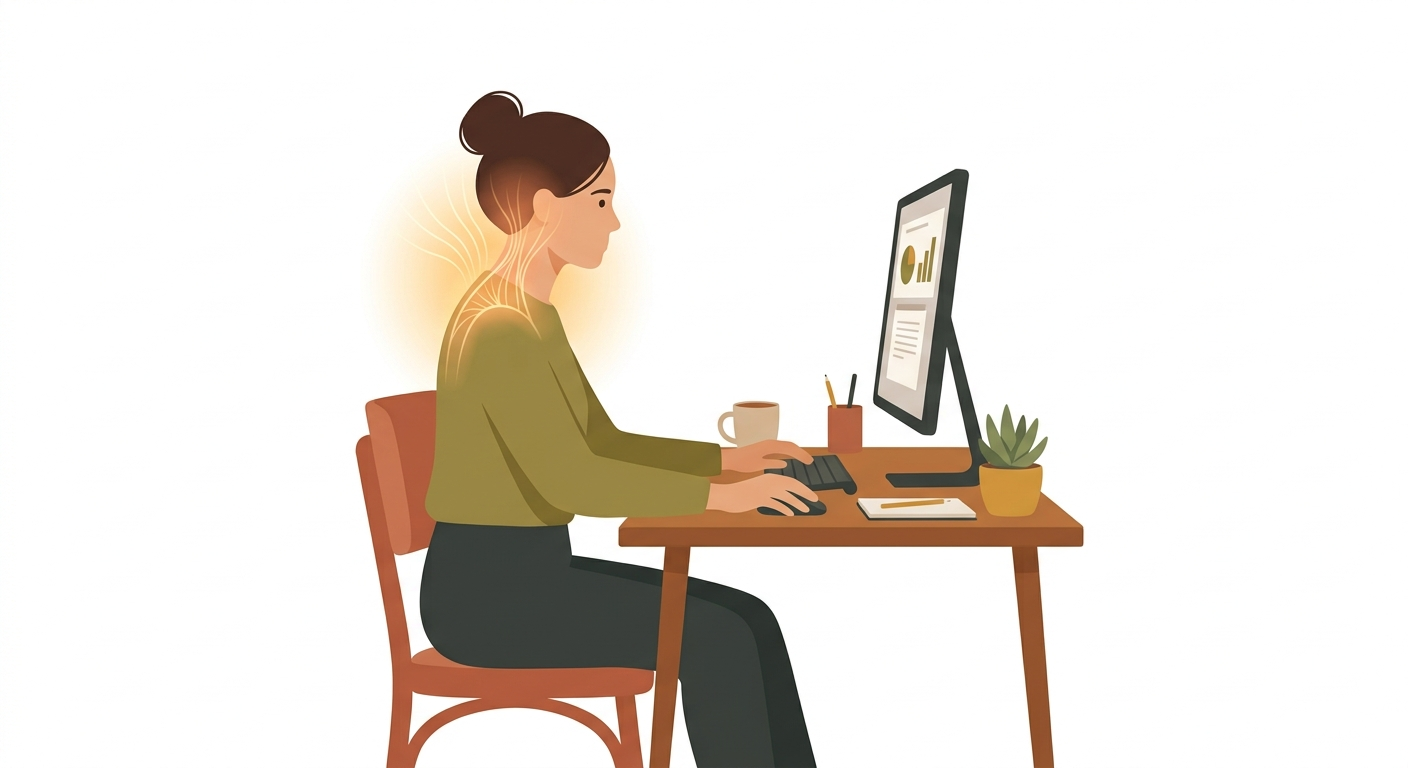
If you work at a desk and find yourself nursing a headache by mid-afternoon, you are not alone. Most of us chalk it up to screen fatigue, stress, or not drinking enough water — and those things can certainly play a role. But there is a surprisingly common culprit hiding in plain sight: muscular trigger points buried deep in your neck and shoulders. Understanding exactly what is happening in those tissues is the first step toward getting real, lasting relief. As a massage therapist serving the greater Madison area, I see this pattern every single week. Let me walk you through what is actually going on.
Ready to stop letting headaches run your day? Book a session with Sam Riddle Massage Therapy in the greater Madison area and find out if trigger point therapy is the answer you've been looking for. BOOK WITH SAM HERE
What Is a Trigger Point — and Why Should You Care?
The term "trigger point" gets thrown around a lot, but very few people actually understand what one is on an anatomical level. A trigger point is not just a sore spot. It is a physically observable change in muscle tissue — a tight, contracted cluster of fibers that researchers at the National Institutes of Health have actually been able to photograph. If you could look at healthy muscle tissue under a microscope, you would see neat, even striations running parallel to each other, like the wood grain on a door. A trigger point looks like a knot in that grain — a localized zone of chaotic, contracted fibers right in the middle of otherwise organized tissue.
How trigger points create constant "background noise" in your nervous system
Here is where things get interesting. That knotted tissue does not just sit there quietly. It is constantly firing a low-level pain signal up into your nervous system — even when you are sleeping, and even when you do not consciously feel pain. Think of it like a fire alarm with a weak battery: not loud enough to make you evacuate the building, but just loud enough to keep you on edge. Over time, this background signal loads up your nervous system until something as small as stubbing your toe or a stressful email is enough to push it over the threshold — and suddenly you have a headache that seems to come from nowhere.
Latent trigger points: the hidden headache you didn't know you had
This is one of the most important concepts I share with my clients. A trigger point can be "latent," meaning it is firing a pain signal to the brain even though you feel nothing unusual in that muscle at rest. You may only notice it once your nervous system is already overloaded. That is why so many desk workers describe headaches that seem random or unprovoked — the trigger point has been silently building pressure for days, and the headache is just the moment the system finally tips over.
The "power strip" model: why one muscle can cause pain somewhere else entirely
Your nervous system is organized a bit like a power strip, with multiple muscles "plugged in" near the same nerve root along the spine. When one muscle — say, your upper trapezius — fires a pain signal repeatedly, the neurotransmitters that carry that signal can build up at the nerve root and accidentally spill over to the neighboring plugs. This is called referred pain, and it explains why a tight muscle between your neck and shoulder can cause a headache, jaw pain, or even eye pressure — without that muscle ever hurting in the traditional sense.
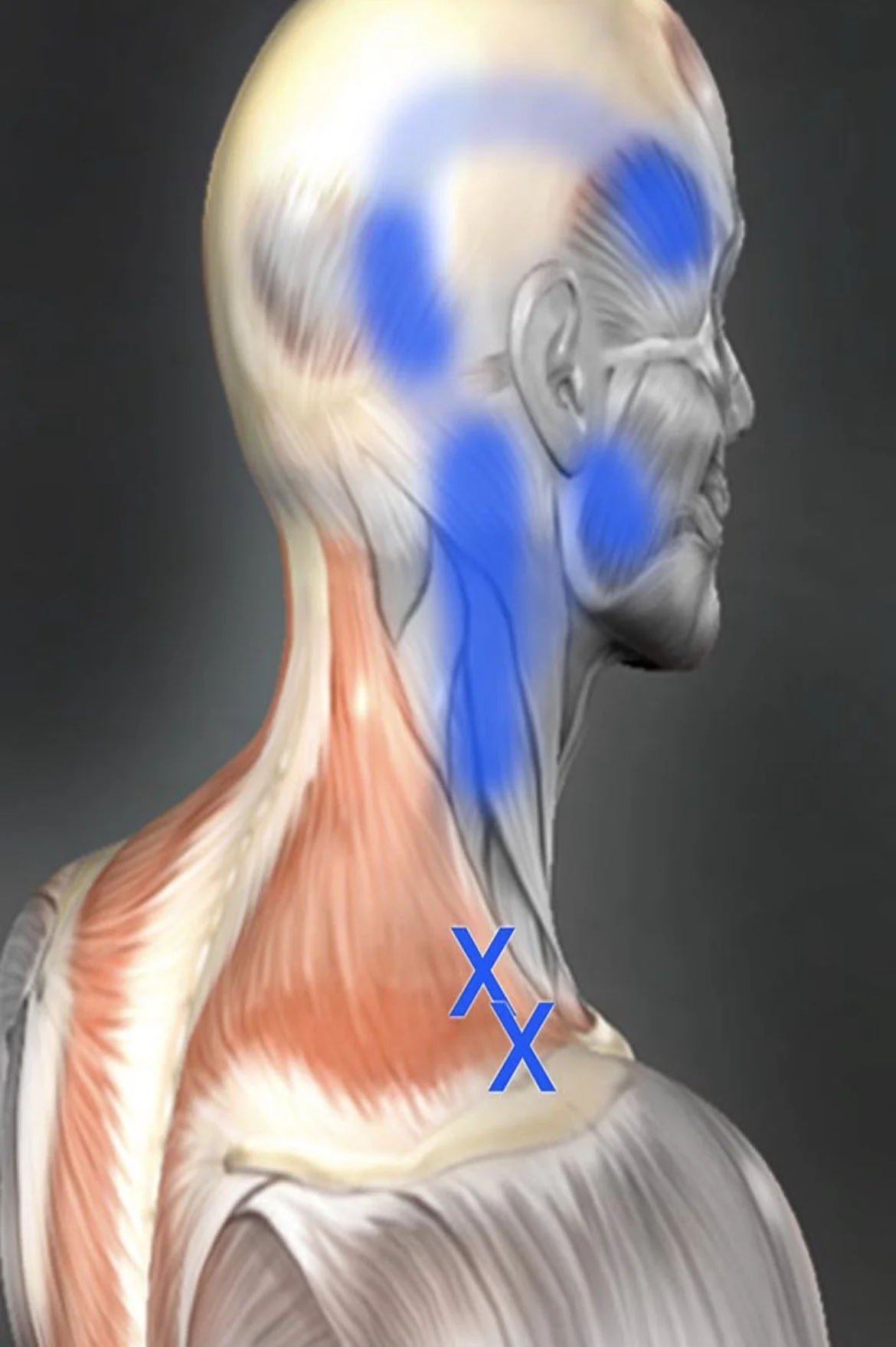
Upper trapezius Trigger Points
The Three Muscles Most Likely Causing Your Headache
There are dozens of muscles in the neck and upper back, but in my experience working with headache clients in Madison, three of them are responsible for the vast majority of tension headaches that desk workers experience. When I address these three areas in a session, the results are often dramatic — and they make a lot more sense once you understand what each muscle is actually capable of.
Upper trapezius: the most common headache hiding spot
The upper trapezius is that broad, kite-shaped muscle that spans from the base of your skull down to your mid-back and out to your shoulders. If you have ever had someone squeeze the ridge between your neck and shoulder and felt an almost electric tenderness there, you have found your upper trap. Trigger points in this muscle can refer pain straight up the side of the neck, into the base of the skull, and even into the jaw or temple — which is why upper trap tension is the single most common source of headache I encounter. The tricky part is that these trigger points are often completely latent: they sit quietly under normal conditions but flare up into a familiar headache pattern whenever your stress level climbs or your posture slips. samriddelmassage.com
Sternocleidomastoid (SCM): the muscle that goes everywhere
The sternocleidomastoid, or SCM, is the ropy muscle that runs diagonally from behind your ear down to your collarbone. You can see it clearly when you turn your head to one side. Trigger points in the SCM are uniquely troublesome because they can refer pain to virtually anywhere on the head and face — the forehead, behind the eye, the cheek, even the top of the skull. They are also unusual in that a tight SCM on one side of the neck can actually cause trigger points to develop in the SCM on the opposite side, and — perhaps most surprisingly — they can provoke trigger point formation in the masseter (your jaw muscle), leading people to assume they have a TMJ problem when the real issue is further down. Trigger points near the ear can also cause dizziness and visual disturbances, which often leads to unnecessary and expensive diagnostic workups.
Sub-occipital muscles: where headaches meet spinal fluid
The sub-occipital muscles are a group of four small muscles nestled at the very base of your skull, right where your head meets your neck. If you have ever turned your head from side to side and heard a grinding or crunching sound — that is often these muscles. They commonly refer pain behind the temple and to the top of the head, but their most significant feature is structural: the deepest sub-occipital muscles are physically tethered to the dura, the tough membrane that sheaths your spinal cord. When these muscles become chronically tight, they can actually restrict the flow of cerebrospinal fluid, allowing pressure to build inside the skull — which means the headache you are feeling may have a direct mechanical cause, not just a chemical or vascular one.
How Massage Therapy Addresses Neck and Shoulder Tension — and Your Headaches
Understanding the anatomy is empowering, but you are probably also wondering: what do we actually do about it? Trigger point therapy is a focused, systematic approach to locating those tight knots of tissue and applying sustained pressure to release them. It is not the same as a general relaxation massage, though a good session will certainly help you unwind. The goal is to interrupt the pain signal, improve blood flow to the restricted tissue, and give your nervous system a chance to reset its baseline.
What to expect during a trigger point massage session
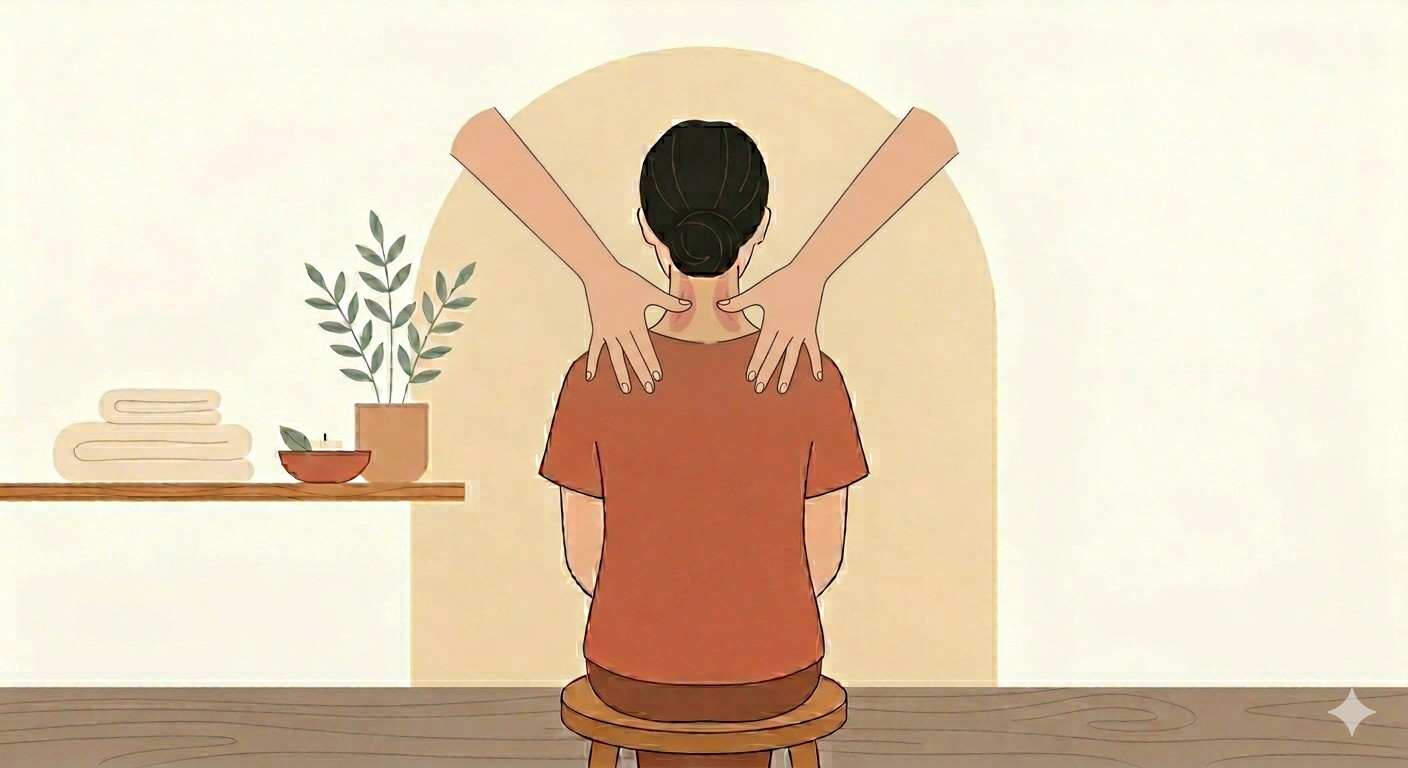
During a session focused on headache relief, I spend significant time on the upper trapezius, SCM, and sub-occipital muscles — the three areas we discussed above. I use a combination of sustained compression, cross-fiber friction, and slow myofascial work to coax those contracted fibers to release. Many clients notice that pressure on a trigger point reproduces their familiar headache pattern, which is actually a helpful sign — it confirms we have found the right spot. Relief often begins during the session itself and continues to develop over the following 24 to 48 hours as inflammation settles.
How many sessions does it take?
This is the question I get most often, and the honest answer depends on how long the trigger points have been active. For someone with a relatively recent pattern of tension headaches, one to three sessions may produce significant change. For someone who has been dealing with chronic headaches for years — common among long-term desk workers in the Madison area — a more consistent schedule of monthly or bi-weekly sessions tends to produce the most durable results. Think of it less like a one-time fix and more like a regular maintenance strategy for your nervous system, much like going to the gym or getting regular chiropractic adjustments.
What you can do between sessions to support your progress
Massage does the heavy lifting, but what you do between sessions matters too. Simple habits like taking a short standing break every 45 minutes, keeping your monitor at eye level so your head is not constantly pitched forward, staying well hydrated, and doing gentle neck stretches throughout the day can all significantly slow the re-accumulation of trigger points. Some clients also find that a tennis ball placed between the upper back and a wall for a minute or two of self-compression helps maintain the work we do together between visits. The more you support the tissue between sessions, the faster you will see lasting change in your headache frequency. stretches for cervicogenic headaches
Headaches are common, but they are not something you just have to accept as part of desk life. More often than not, the pain you feel in your head has its roots in the muscles of your neck and shoulders — muscles that are doing their best to hold you upright hour after hour while you work. When those muscles develop trigger points, they create a steady undercurrent of tension that eventually has to go somewhere. For most people, it goes straight to the head. The good news is that trigger point massage is one of the most direct and effective tools available for addressing that underlying cause, not just masking the symptom.
If you are in the greater Madison area and you are tired of reaching for ibuprofen every afternoon, I would love to help you figure out what is actually driving your headaches. Every body is different, and the first step is just having a conversation about what you are experiencing. Book your appointment below — let's get to the root of it.