
Summer is here , let us talk about preventing low back pain
My favorite time of year is here. The sun is out and the temperature is right where I like it. All of my flowers are awaking from their slumber and its time to plant the vegetable garden and spruce up all the garden beds.
This also brings up the opportunity to talk about low back pain.
My brother said something one day that made a good point, he was putting flag stone down for a path at my parents house and heard him say “I have 3 more bend overs left where are they going to happen”.
There are a lot of reasons that folks make it into my office for low back pain , but the most common is an injured multifidus muscle. Multifidus is your main postural muscle. it is really good at keeping ua up straight all day. Multifidus is also easily tired when we bend over as it is really designed to keep us in an upright position. In fact if we bend over for 20 minutes picking up sticks or pulling weeds it takes a healthy multifidus 7 plus hours to fully recover. The yard work you just did may not take you out but until that muscle relaxes it does not take much to put the multifidus into spasm.
That means don’t forget to take breaks and when possible bend your knees and come down to ground level to get the job done and save your bend overs for another task.
By Sam Riddle | Sam Riddle Massage Therapy | Madison, Wisconsin | Spring 2026
Low Back Pain and Yard Work: What Every Madison GARDENer Should Know Before Digging In This Spring
Spring in Madison is pure magic — and it's also the season when low back pain spikes in my practice at Sam Riddle Massage Therapy. If you're a homeowner planning to tackle your garden beds this weekend, read this before you grab your shovel.
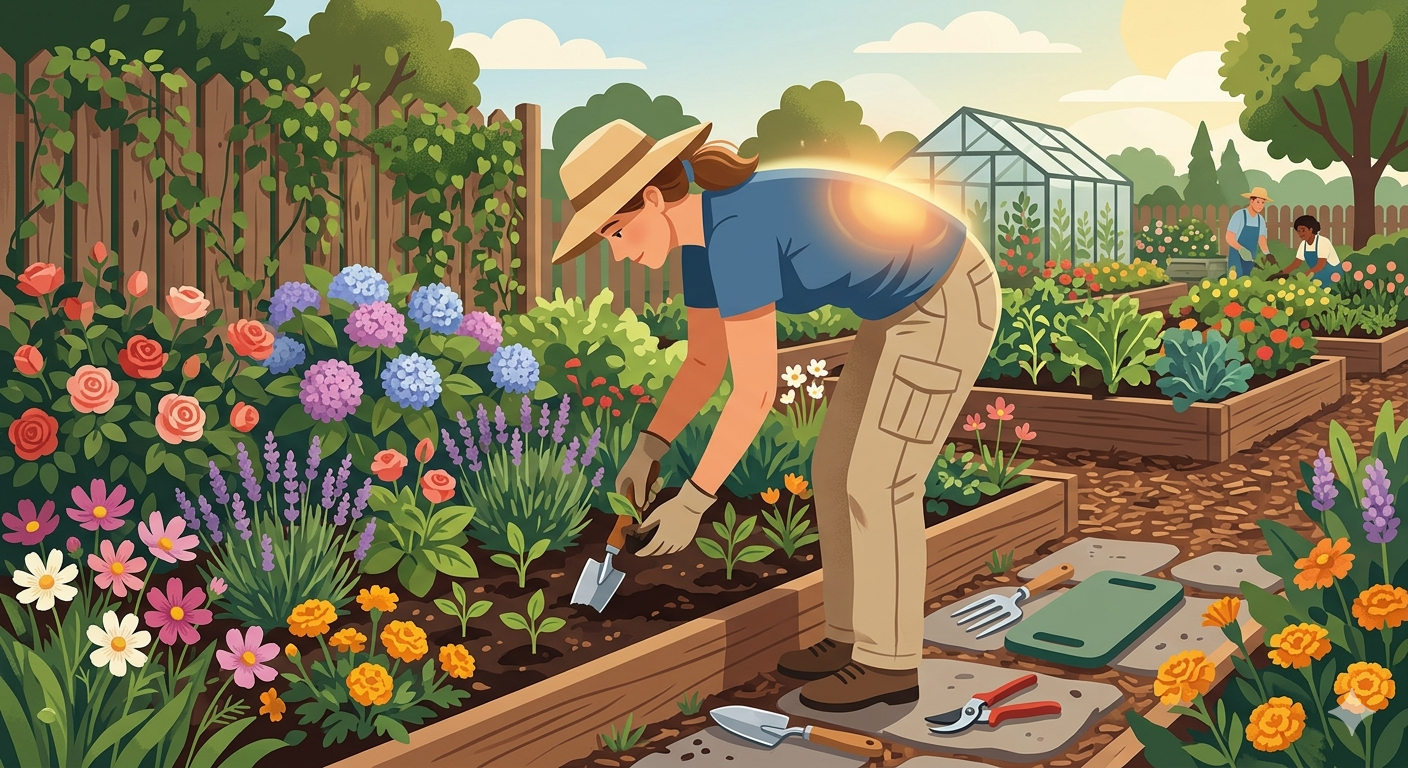
Spring yard work is one of the leading causes of low back pain for adults aged 30–60. Your multifidus muscle may be more exhausted than you think.
Is Low Back Pain Slowing You Down This Spring?
At Sam Riddle Massage Therapy in Madison, WI, we specialize in muscular low back pain, sciatica, and lumbar pain relief. Don't wait until you're laid up on the couch.
My favorite time of year is finally here. The sun is out, the temperature is right where I like it, and my flowers are waking up from their long winter slumber. It's time to plant the vegetable garden, haul mulch, and finally get those garden beds looking sharp again. If you own a home in Madison, you know exactly what I mean — and you're probably already making your weekend to-do list.
But this season I love so much also gives me a lot to talk about professionally. Every spring, low back pain spikes dramatically when people head outside to tackle their yards. At Sam Riddle Massage Therapy, I see it year after year, and the cause is almost always the same muscle.
"I have three more bend-overs left — where are they going to happen?"
My brother said that while laying flagstone at my parents' house. I laughed, but honestly? He was onto something important. That one offhand comment captured something I spend a lot of time explaining to clients. You only have so many bend-overs in the tank on any given day — and most people burn through them without even realizing it.
So before you head out this weekend and spend three hours hunched over your raised beds, let's talk about what's actually happening in your lower back, why the multifidus muscle is almost always the culprit, and how to avoid becoming my next appointment.
Why Your Lower Back Takes the Hit Every Spring
Low back pain from yard work isn't bad luck. It's predictable, and it has everything to do with how your postural muscles are built — and what they aren't built to handle when you spend a Saturday morning in the garden.
Meet the Multifidus: Your Body's Unsung Postural Hero
The multifidus is a deep spinal muscle running along your lower back, and its primary job is keeping you upright. It's remarkably good at that — firing almost continuously throughout the day to hold your spine in alignment. But it has a significant weakness: it was designed for keeping you vertical, not for bending forward over and over again.
When you spend even 20 minutes pulling weeds, picking up sticks, or leaning over a garden bed, you're asking the multifidus to do something it was never optimized for. The result is a muscle that fatigues faster than almost any other in the body during repetitive, forward-flexed movement. And here's the part that surprises most people — a healthy multifidus can take seven or more hours to fully recover from a prolonged bending session.
Learn how massage therapy targets the multifidus and deep spinal muscles: samriddlemassage.com
The Delayed Spasm Trap
This is what trips most people up. You spend Saturday morning in the garden, feel completely fine afterward, and think you got away with it. But your multifidus is still depleted — and while it's in that fatigued state, it doesn't take much to push it into full spasm. Maybe you reached for something on a low shelf Sunday morning. Maybe you loaded the dishwasher. Maybe you bent down to tie your shoe.
That tiny movement becomes the straw that breaks the camel's back — literally. The yard work from the day before was the real culprit. The dishwasher just got the blame. This is why low back pain from weekend yard work so often shows up Monday morning, leaving people convinced they "slept wrong" when the real problem was Saturday's flower bed.
Think of it this way: Your multifidus has a daily budget of bending capacity. Once that budget is spent — even if you feel fine in the moment — any additional demand can tip it into spasm. Breaks aren't laziness. They're deposits back into that account.
Why Madison Homeowners Are Especially Vulnerable in Spring
After a long Wisconsin winter, most of us have been less physically active than usual — sitting more, moving less, with core and postural muscles that have quietly deconditioned over months. Then the first warm weekend arrives and we go from zero to six hours of yard work in one shot. The multifidus, weakened from months of relative inactivity, simply isn't ready for that kind of demand all at once.
Combine that with the enthusiasm spring brings — and honestly, there's a lot to catch up on after a Wisconsin winter — and you have a reliable recipe for the kind of lumbar pain that sends people to Sam Riddle Massage Therapy on Monday morning looking for answers. You aren't out of shape. You're just asking a muscle to do something it hasn't trained for in months, all at once, without enough recovery built in.
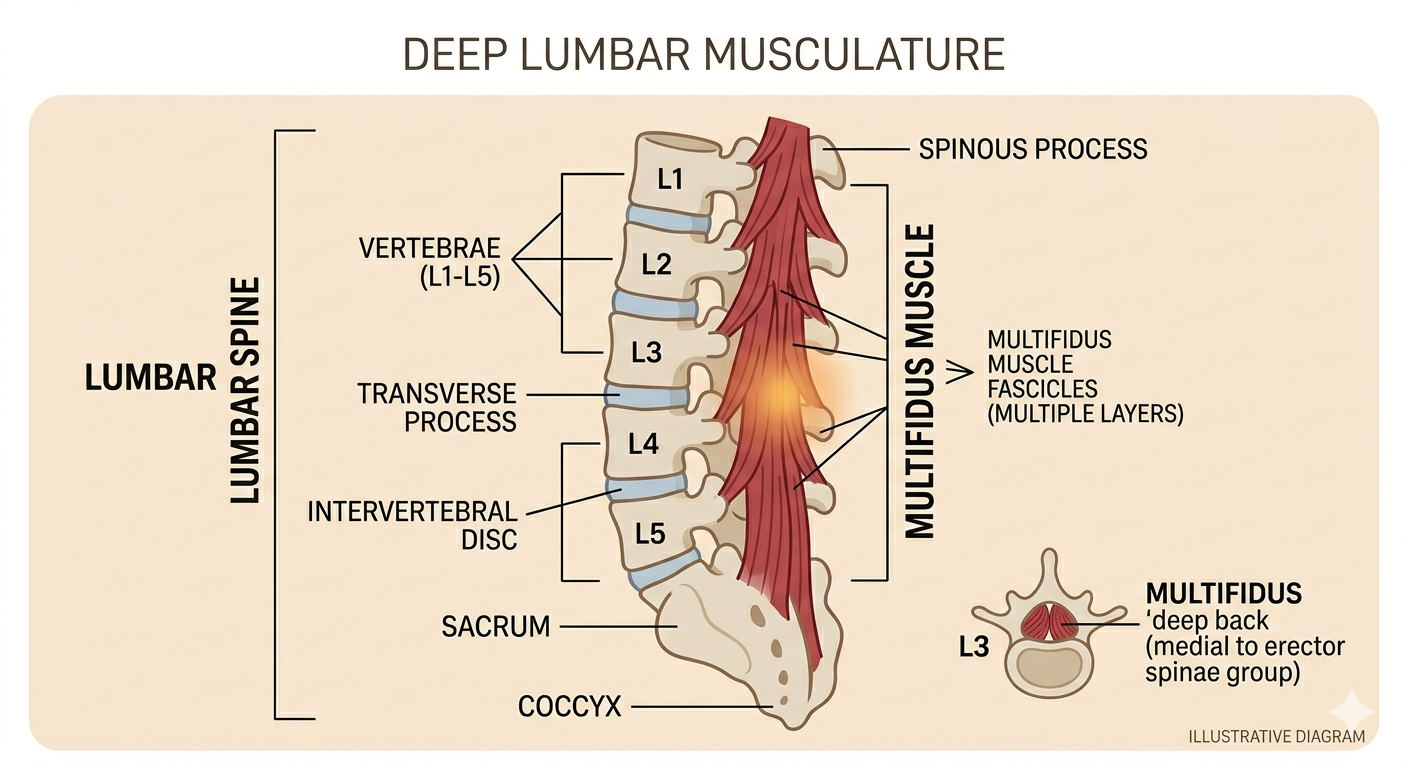
Multifidus is the deepest set of low back muscles.
The multifidus runs alongside your lumbar vertebrae and is the primary stabilizer of your lower spine. When it fatigues, your whole lower back becomes vulnerable.
The Connection Between Yard Work, Lumbar Pain, and Sciatica
Low back pain is rarely just about the back. For many clients I see at Sam Riddle Massage Therapy, what starts as a tight, achy lumbar region can escalate quickly — especially when the underlying muscle tension goes unaddressed. That's when lumbar pain and sciatica enter the picture together, and things get significantly more uncomfortable.
When Lumbar Pain Becomes Something More
Lumbar pain — that deep, sometimes burning ache in the lower back — is your body's early warning signal that something in the posterior chain is under stress. When the multifidus goes into spasm, it can compress the structures around it, including the lumbar vertebrae themselves. Over time, or when the spasm is severe, this compression begins to affect the nerves exiting the spinal column.
The good news is that most lumbar pain caught early responds beautifully to targeted manual therapy. Clients who come in while still in that "sore but functional" phase give us the best window to address the muscular tension directly, calm the nervous system, and prevent the pattern from deepening. Waiting gives that tension time to entrench — and what could have resolved in a couple of sessions may instead take weeks.
Understanding Sciatica and Its Yard Work Link
Sciatica refers to pain that travels along the path of the sciatic nerve — from the lower back, through the glutes, and down one or both legs. It can feel like a sharp electric jolt, a deep ache, tingling, or even numbness. When the muscles of the lumbar region and glutes are tight and inflamed from overwork, they can irritate or compress the sciatic nerve directly.
Yard work is a surprisingly common trigger for sciatica flare-ups, particularly for people who already carry some underlying tension in the piriformis and glute muscles — which honestly describes most of us. Repetitive bending, twisting to haul bags of mulch, or kneeling on hard ground for extended periods can be enough to set it off. If you've ever stood up from planting annuals and felt a sharp pain shoot down your leg, you've had a firsthand introduction to sciatic nerve irritation.
Sciatica vs. general low back pain: If your pain travels below the fold of the glute, or if you're noticing tingling or weakness in a leg, that's worth getting evaluated promptly. Sciatica caught early is far easier to treat than sciatica that's had weeks to dig in.
How Massage Therapy Addresses Both at Once
One of the things I love most about this work is that a well-designed session at Sam Riddle Massage Therapy can simultaneously address the muscular sources of lumbar pain and the compressive factors contributing to sciatica. By working on the multifidus, the erector spinae, the piriformis, and the surrounding hip musculature, we release the tension that's pulling on the spine and irritating the nerves — without cracking, adjusting, or guesswork.
The goal isn't just to make you feel better for a day. It's to restore the muscle's ability to function properly so it can protect your spine the way it's designed to. Clients who come in regularly through the spring and summer season — especially those tackling heavy yard work — tend to avoid acute flare-ups entirely. When it comes to low back pain and sciatica, prevention really is the best treatment there is.
How to Protect Your Back This Season: Practical Strategies That Actually Work
The best thing about understanding the multifidus is that once you know how it works, protecting it becomes straightforward. No complicated training program, no special equipment. Just a few smart habits — and a willingness to take that break before you feel like you need one.
Budget Your Bend-Overs Like They're Currency
This is the lesson my brother taught me without knowing it. Before you head outside, decide in advance where your most demanding bending tasks are, warm up/stretch and tackle them first, while the multifidus is fresh. Pruning, digging, and planting all demand more from your postural muscles than watering or raking. Front-load the hard stuff, and save lighter tasks for later in the session when your back's capacity is lower. In addition mind the positions you hold after working hard (If you lay down and cross your legs for along time after you may end up stuck that way).
The other side of this is accepting that you genuinely cannot do everything in one marathon session without paying for it later. Splitting your work across two shorter sessions on separate days will always serve your back better than grinding through a single long afternoon. Madison weekends are too short and too good to spend laid up on the couch — protect them by not overdoing it on Saturday.
Take a Break Every 15–20 Minutes — Before You Feel Like You Need One
This is the tip that surprises people the most, but the science behind it is simple: your multifidus begins accumulating significant fatigue well before you feel it. By the time your back starts aching, that muscle has often been struggling for a while. Setting a timer to pause for 5–10 minutes every 15 to 20 minutes of active bending and lifting lets the multifidus cycle back toward readiness before it hits its limit.
During those breaks, stand fully upright, walk around, and gently extend through the spine — the opposite motion from what you've been doing. Even a few slow, deliberate stand-up-and-look-at-the-sky moments can meaningfully reduce the fatigue load accumulating in your lower back. I tell my clients to think of these breaks not as interruptions to the work, but as part of the work itself — because they're what make the next session of bending possible.
The 15–20 Minute Rule:Set a phone timer. Every 15–20 minutes of bending or low-level work, stop and stand fully upright for at least 5 minutes. Walk around, reach your arms overhead, let your spine decompress. This single habit can dramatically reduce your risk of a multifidus spasm — and the Monday morning low back pain that follows.
Get Low, Save Your Back
One of the most effective changes you can make is simply adjusting your relationship to the ground. When working at ground level — pulling weeds, planting seedlings, edging beds — get all the way down rather than bending at the waist. Use a garden kneeling pad, sit on a low stool, or drop to one knee. Your lumbar spine will thank you enormously. The multifidus is far happier in a neutral or slightly extended position than sustaining that long forward-folded angle over a garden bed for 20 or 30 minutes at a stretch.
When you do need to bend, hinge at the hips rather than rounding through the lower back — and when picking up anything heavier than a watering can, bend your knees and let your legs carry the load. These aren't new tips. But they're the ones that consistently prevent the Monday morning low back pain appointment, so they're worth repeating every single spring.
Body mechanics and everyday low back pain prevention → [Link to: Blog / Body Mechanics for Low Back Health]
If Your Back Is Already Sore: Two Simple First Steps Before Anything Else
Even when you do everything right, a long day in the garden can leave your lower back complaining by evening. If you wake up the morning after yard work with that familiar stiffness and ache, resist the urge to either push through it or park yourself on the couch for the day. Both of those approaches tend to make things worse. Instead, there are two simple, effective steps I recommend to clients as first-line self-care for muscular low back pain — and they cost nothing.
The first is heat. A heating pad applied to the lower back for 15 to 20 minutes does several important things at once: it increases local circulation, encourages the fatigued multifidus to relax out of protective tension, and signals the nervous system to downregulate the pain response. Moist heat tends to work better than dry heat if you have the option — a damp towel between the pad and your skin works well. Don't use ice on a back that's stiff and achy from overuse. Cold is better suited for acute trauma and swelling; for a muscle that's sore from fatigue and tension, heat is your friend.
The second step is a walk — a real one, not just laps around the kitchen. Gentle, continuous forward movement is one of the most therapeutic things you can do for a sore low back. Walking encourages the spine to move through its natural range of motion, pumps fresh circulation into the fatigued tissues, and helps interrupt the pain-spasm cycle that can take hold when an overworked muscle tightens up overnight. Even 10 to 15 minutes at an easy, comfortable pace can make a meaningful difference in how your back feels. If your neighborhood has gentle terrain, even better — flat, even ground is all you need.
At-Home First Steps for Gardening-Related Low Back Pain:1. Apply a heating pad to your lower back for 15–20 minutes. Moist heat is ideal — skip the ice for this type of soreness.
2. Go for a 10–15 minute walk at an easy pace on flat ground. Movement, not rest, is what your back needs most.
If soreness persists beyond a day or two, or if pain is shooting into your legs, contact Sam Riddle Massage Therapy — that's exactly what we're here for.
These two steps won't undo a serious injury, and they aren't a substitute for professional care if your symptoms are severe or persistent. But for the common post-yard-work low back soreness that most Madison homeowners know all too well, heat and a walk are the right starting point — and they set up your muscles to respond much better to massage therapy when you do come in.
What to expect at your first appointment for low back pain → [Link to: FAQ / What to Expect]
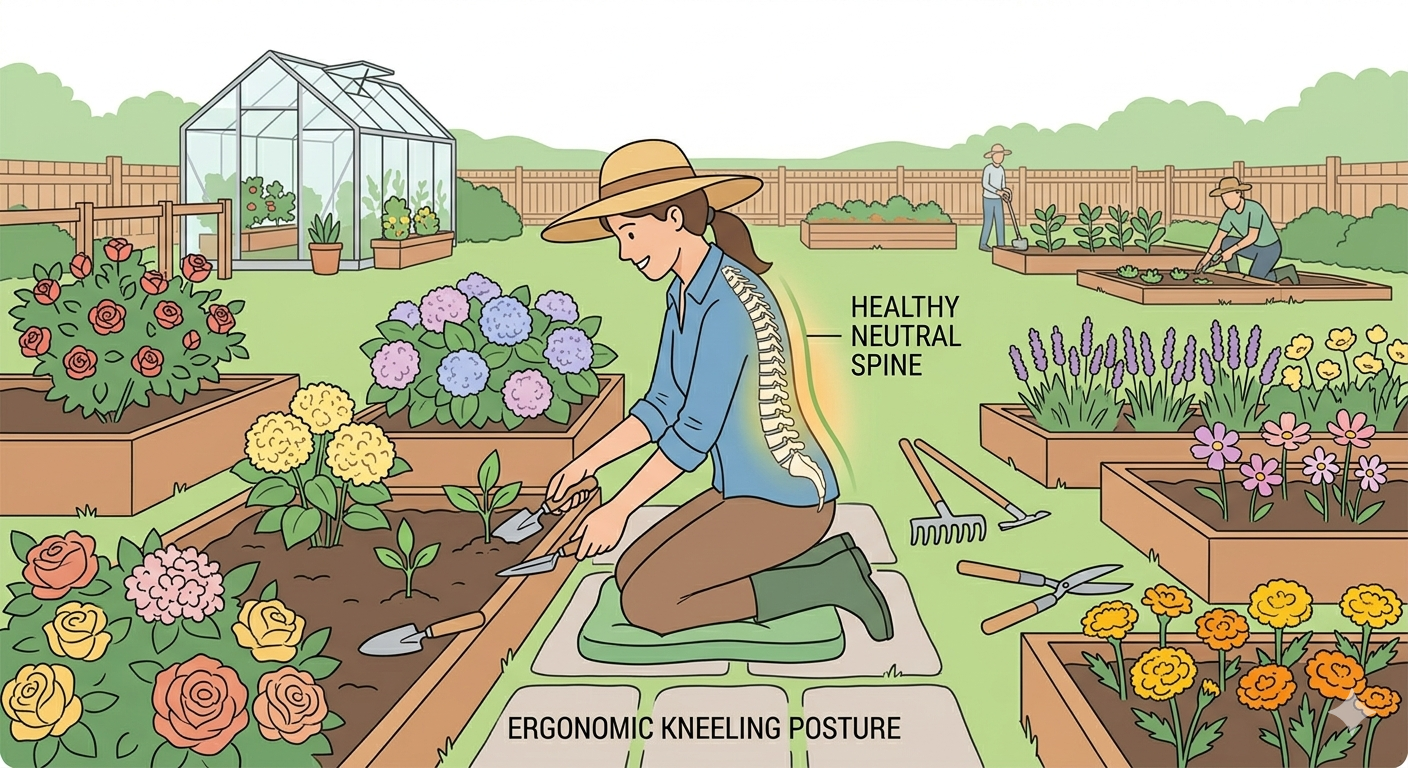
Spring in Madison is short and beautiful, and you deserve to enjoy every bit of it — not spend half of it recovering from a preventable low back injury. The multifidus is doing its absolute best for you every day. Give it the respect it deserves: budget your bend-overs, take a break every 15 to 20 minutes, get low when you can, and let your legs do the heavy lifting.
And if your back is already talking to you after a long weekend in the garden? Start with heat and a walk. That combination handles a lot. If things don't settle down within a day or two — or if pain is traveling into your legs — that's your cue to call us. At Sam Riddle Massage Therapy, we work with Madison homeowners every spring to address exactly this kind of muscular low back pain, and the sooner you come in, the faster we get you back outside doing what you love.
Book your appointment online or give us a call. We're right here in Madison, and we know exactly what your weekends look like this time of year.
Ready to Feel Better?
Don't let low back pain steal your spring. Sam Riddle Massage Therapy is here to help Madison homeowners move freely and feel their best all season long.
Schedule Your Session at Sam Riddle Massage Therapy →
SEO Reference — For Your Web Team
Primary Keyword: low back pain
Secondary Keywords: sciatica, lumbar pain, Sam Riddle Massage, Sam Riddle Massage Therapy
Target Audience: Homeowners aged 30–60 in Madison, Wisconsin
Meta Description (158 characters):
Low back pain from yard work spikes every spring in Madison. Sam Riddle Massage Therapy explains why the multifidus is the culprit — and how to protect your back.
Keyword Usage Notes:
"Sam Riddle Massage Therapy" appears naturally 8 times throughout the post — in the intro, CTAs, section body copy, and conclusion. This supports local branded search without keyword stuffing.
"Low back pain" appears in the H1, intro pull quote, and throughout all three H2 sections.
"Sciatica" is introduced early in Section 2 and used in alt tags and CTA copy.
"Lumbar pain" appears in the H2 header and supporting paragraphs of Section 2.
Suggested Internal Links:
Services / Deep Tissue Massage — anchor: "massage therapy targets the multifidus and deep spinal muscles"
Blog / Benefits of Year-Round Massage — anchor: "keeps postural muscles primed"
Services / Sports and Injury Massage — anchor: "how Sam Riddle Massage Therapy approaches lumbar pain"
FAQ / Conditions We Treat — anchor: "Is massage therapy right for your sciatica"
Blog / Body Mechanics for Low Back Health — anchor: "body mechanics and everyday low back pain prevention"
FAQ / What to Expect — anchor: "What to expect at your first appointment for
By Sam Riddle | Sam Riddle Massage Therapy | Madison, Wisconsin | Spring 2025